
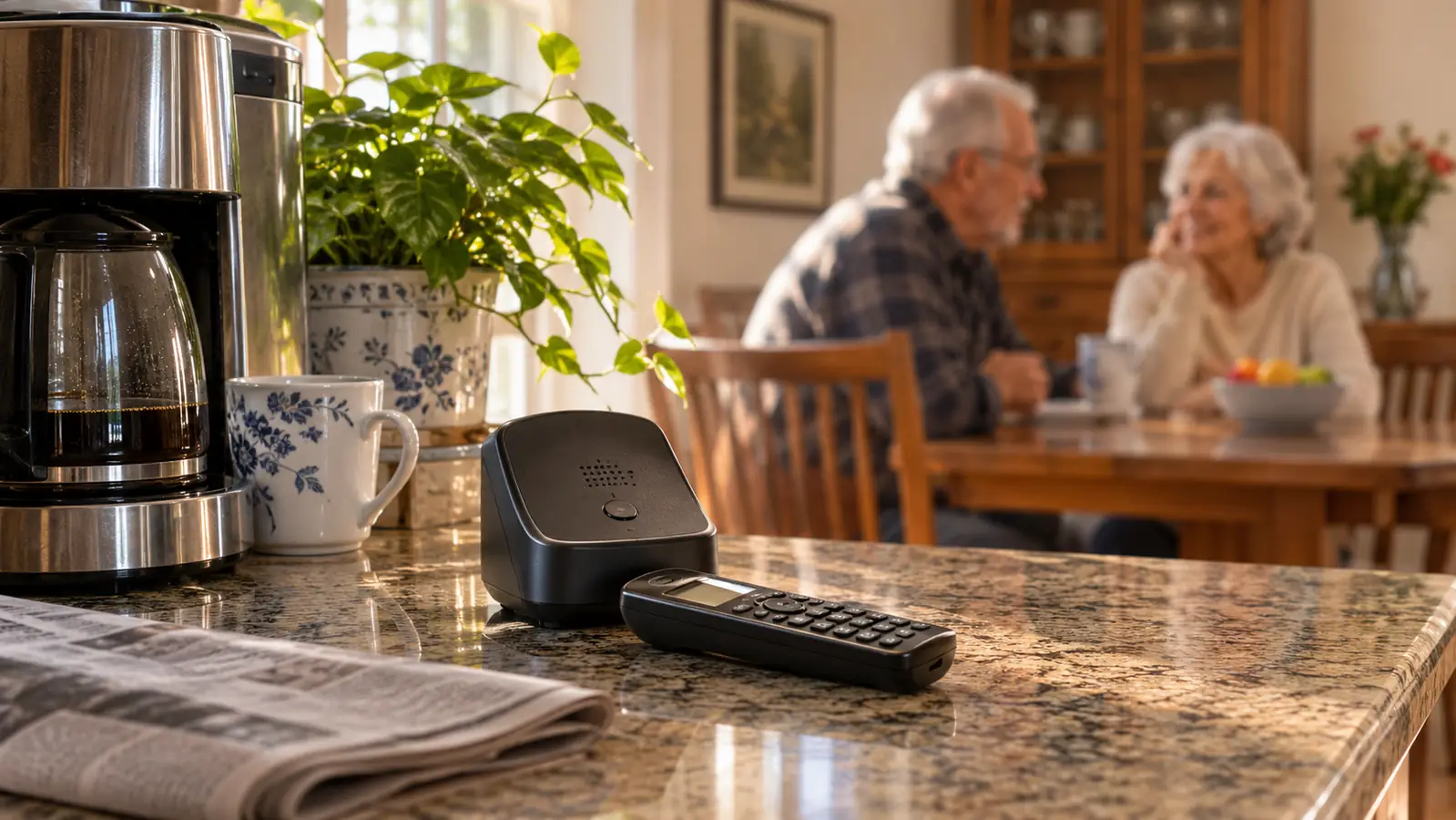
The first time I understood how bad it had gotten, Walt handed me the phone in the middle of a sentence and told me to talk to her instead. It was our daughter, calling from a parking lot, and he had not caught a word of it. Walt is 75 and has moderate hearing loss in both ears. He does not wear hearing aids yet, and he is stubborn as a fence post, so the problem sat in our kitchen for another year while he nodded along to conversations he could not follow. If you are reading this, you probably have someone like that in your family. Maybe you are the one who keeps getting handed the phone.
What finally fixed it was not a gadget with an app on it. It was a plain cordless phone with a volume button that goes loud enough to matter. I bought the VTech amplified cordless senior phone in January 2025 to replace the old handset Walt could no longer hear on. The base sits in the kitchen and a second handset lives in the den, and he uses the volume boost on every call he takes. I want to be clear about what this is. It is not a hearing aid, and it will not repair anyone's ears. What it does is put a speaker and a mouthpiece in your grandparent's hand that were built for ears like theirs, which is a different job entirely.
Below is what we actually did, in the order we did it, over about two weeks in January. None of it requires a laptop, an account, or a trip to a store. Most of it takes ten minutes, and the only equipment you need is one relative on the other end who is willing to be the test caller.
The handset that ended the handoff in our kitchen
A cordless system with a 90dB ringer, a one-touch Audio Assist boost, big buttons and a backlit display. Set it up once and your grandparent can answer without calling you first.
Amazon Check Today's Price on Amazon →Step 1: Put the base where your grandparent already sits
The most common mistake I see in other people's houses is a phone in the hallway, near the jack, where nobody sits. If the phone is two rooms away, your grandparent will not walk to it, and if they do, they will be out of breath before they say hello. Ours used to live on a little table in the hall. Walt let it ring out more often than he answered it, and I blamed his hearing when the real problem was the walk.
We moved the base to the end of the kitchen counter, near the chair where he reads the paper, and put the second handset in the den where he watches television and dozes off in the afternoon. That is the whole trick. The phone has to be within arm's reach of the two places he spends his day, or nothing else in this article matters. The display on the VTech base is extra large and backlit, so he can read who is calling from across the room without hunting for his glasses, and the oversized buttons are wide enough for hands that have some arthritis in them.
One practical note: pick the spot before you unpack anything, and stand in it yourself. Sit where they sit. Look at where the handset will land when they set it down, because it will not go back on the base neatly. Walt sets his on the arm of the chair, so I put a small tray there and stopped arguing about it.
The second handset earns its keep. Walt watches television in the den from about two in the afternoon until dinner, and a phone in another room may as well be in another county. He keeps a handset on the table beside his chair and the base in the kitchen, and after a year of this he still reaches for it without looking. That is what you want. Not a phone he admires, a phone he forgets is there until it rings.

Step 2: Set the ringer while you are standing in the next room
The ringer on this phone is rated at 90 decibels, which is roughly a lawn mower at a distance, and there is a flashing light that goes with it. Do not set it by ear while you are holding the phone. Have someone call from a cell phone outside, then walk to the room where your grandparent naps and listen from there. That is the only test that tells you anything.
In our house the ringer is one notch below the top setting. At the maximum, Walt jumped every time and then complained that the phone was shouting at him. One notch down still reaches the den through a closed door, and the flashing indicator covers the times he has the television up. If your grandparent naps with a fan on, test it with the fan on. If they take their hearing aids out in the afternoon, test it then too. The point is to test it in the conditions they are actually in, not the quiet ones you wish they were in.
The flashing indicator is the part people underestimate. A loud ringer tells you a call is coming. A light tells you a call is coming when the ringer is competing with a television, a furnace, or a fan, and it also tells you the call is still there when you have walked into the room a beat late. If the phone sits where your grandparent can see it from their chair, the light does half the work for you.
Step 3: Set the volume boost together, once, and leave it there
The feature that matters most is the one-touch Audio Assist, which adds up to 50 decibels of volume on a call. It is a button, and a button only helps if the person knows which one it is and trusts it not to break something. So do not set it for them. Sit beside them and let them press it themselves, on a real call, three or four times, until their thumb finds it without looking.
Walt had it backwards for the first week. He would press it, hear the jump, decide it was too loud, press it again to turn it off, and then spend the rest of the call leaning forward. What fixed it was a small square of masking tape with an arrow drawn on it, stuck next to the button on the VTech handset. That is not elegant. It is also still there fourteen months later, so it worked.
One thing worth saying plainly: if your grandparent has the boost on and still cannot follow the conversation, that is not a phone problem and no amount of shopping will solve it. That is a hearing evaluation. The phone buys you time and dignity in the meantime, which is worth something, but it is not a substitute for the appointment.
Test the boost with the quietest caller in the family. In ours that is a granddaughter who talks fast and low, and she is the one who used to get handed off to me. Have that person call, with the boost on, and ask a question that requires a real answer instead of a yes or a no. Yes or no hides everything. What did you have for lunch hides nothing.
For the first time in about two years, Walt took a whole call from his sister without handing the phone to me. Then he went back to his chair and said nothing about it, which from him is a rave review.

Step 4: Record the greeting and turn on call blocking
The answering machine on the VTech holds about 22 minutes of messages, which is more than enough for a household that gets four real calls a week. Record the greeting in your grandparent's own voice, slowly, and keep it short: name, please leave a message, we will call you back. A long greeting is a wall. People hang up in the middle of it.
Then set up call blocking. Walt was getting four or five robocalls a day on the old line, and by the end he had stopped answering anything he did not recognize, which meant he also stopped answering his sister when she called from a new number. Blocking the nuisance callers gave him back the habit of picking up. Do this part with him, not for him, so he knows the phone is not simply refusing to ring.
Write the four steps for checking messages on an index card and tape it inside the cabinet door above the phone. Walt will not read a manual and neither will most people his age. He will read a card, at eye level, in his own kitchen, roughly a hundred times, and then he will know it.
Step 5: Make one real call, then stop adjusting things
The last step is the one adult children skip. Once the phone is set up, call it. Talk for ten minutes about nothing. Let your grandparent hang up first, then call back and let them answer. The big buttons and the backlit display only become familiar through use, and the first real call is the one where the learning happens.
Then leave it alone. Every visit, resist the urge to improve the settings, reorder things, or add something new. I have watched a well-meaning relative reset a perfectly good phone because he thought the ringer should be louder. It took his grandmother three weeks to trust it again, and she never did learn the new arrangement.
The three-way calling is there if two grandchildren want to pile onto one call, and it is worth showing them once, because it is the kind of thing that gets used at Christmas and forgotten by February.
Pick one person in the family to be the phone person. Not a committee, one person, and let everyone else route questions through them. In our house that is me, mostly because I am here. If you live out of state, it can be a neighbor with a key and a willingness to be called. What you cannot do is have three adult children each adjusting the settings on separate visits, because that is how a working phone becomes a confusing one.
What Else Helps
A phone is one tool among several, and the rest of the list costs nothing. Get the hearing checked. Walt has been putting off an appointment for two years, and I have stopped nagging and started booking it myself, which is a different kind of pressure. If your grandparent turns out to be a candidate for hearing aids, the phone will still be useful afterward, but it will not be carrying the whole load.
Cut the background noise on both ends. Turn off the television before dialing. Do not call from a windy parking lot or a restaurant. On the other end, ask them to turn the radio down before you start talking, because they will not think of it themselves. Half of what people call hearing trouble on the phone is really one room full of noise competing with one small speaker.
Speak at your normal volume and slow down slightly. Do not shout. Shouting distorts the sound and makes it harder, not easier, and it also makes the person on the other end feel like a burden. If they miss something, say it again in different words rather than repeating the same sentence louder. And call at the same time each week, because a predictable call gets answered and an unpredictable one gets missed.
Keep a paper list of family numbers inside the cabinet door, next to the index card. Not in a phone, not in an app, on paper, in the kitchen, in handwriting they recognize. It sounds old-fashioned because it is, and it has saved more calls in this house than any feature on any device. The VTech unit has been in daily use here for fourteen months now, through one battery change and a lot of dropped handsets, and it has not given us a moment of trouble.
One more thing, and then I will get off the subject. A cell phone is not a substitute in a house like ours. The reception at the kitchen table is poor, the screen is small, and Walt has never once answered a call on a smartphone without pressing something wrong first. If the landline is still wired into your grandparent's house, keep it. It rings and someone picks it up, and that is most of what a phone needs to do at 75.
And if you are the grandchild reading this on behalf of a parent who is doing the caregiving, the most useful thing you can do is not buy the phone. It is to be the test caller. Call on a Tuesday evening, ask a question with a real answer in it, and let your grandmother hear you clearly enough to answer without asking you to repeat yourself. That is the whole point of the exercise, and it does not cost a thing.
If your family still plays pass-the-phone, start with the ringer
The settings that matter most are the ringer, the volume boost, and where the base sits. Two of those are free. The third is a VTech phone that goes loud enough for the person holding it.
Amazon See the VTech amplified phone on Amazon →