
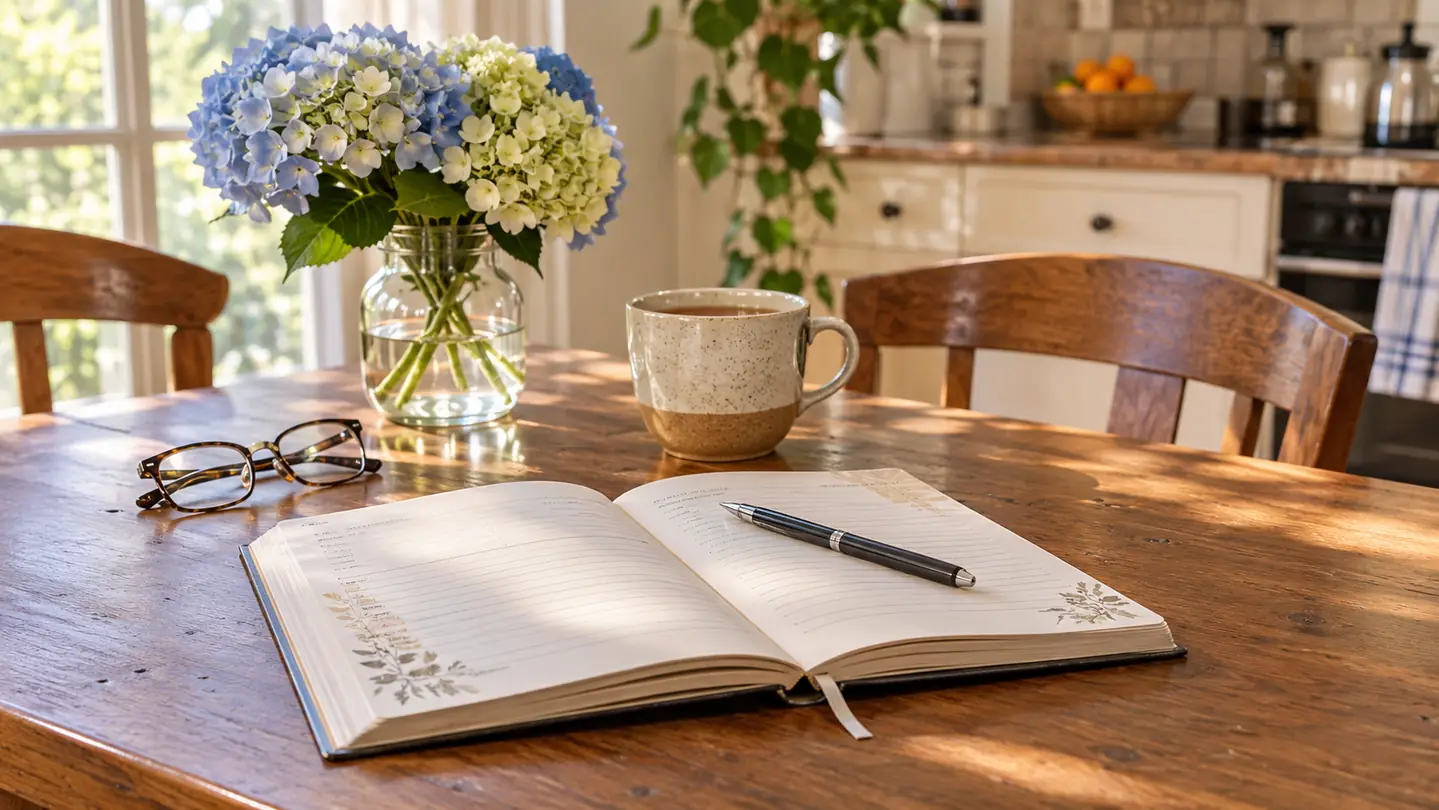
My 19-year-old grandson handed me a padded envelope on Mother's Day 2025 and made me promise not to open it until he had driven back to school. Inside was Tell Me Your Life Story, Grandma, published by Questions About Me. That was the entire gift, no card and no flowers. I have been writing in it on Sunday afternoons ever since, and by the middle of autumn I was a little past halfway through the 122 pages. So this is not a review from someone who flipped through the book for ten minutes at the kitchen table and formed an opinion. It comes from someone who has sat with it for months, at the dining table, with a pen and a cup of tea that goes cold before I finish a page.
Most of what gets written about a journal like this comes from the person who bought it, and buying is the easy part. The hard part is the grandmother, the pen, and the Sunday afternoons. I am 72, a retired elementary school librarian in Lancaster, Pennsylvania, and I kept a diary on and off from the age of eleven, so I am not the hardest case to please. Even so, there are things about this book I would want to know before spending money on it, and a few I would want a grandchild to know before handing it over.
The Quick Verdict
A well-organized set of prompts that will pull a real story out of a willing grandmother. It asks for a year of Sunday afternoons rather than one rainy weekend, and it is the wrong gift for anyone who does not like putting words on paper.
Amazon Check Today's Price →The gift that got a story out of me, not just a thank-you note
Tell Me Your Life Story, Grandma runs 122 pages and moves through a whole life in order. If the woman you are buying for writes letters, keeps a diary, or tells the same stories at the table with her hands moving, she will use this one.
Amazon Check Today's Price on Amazon →What Nobody Tells You: The Book Is the Easy Part
A guided journal is not a book you read. It is a book you fill, and everything that makes it worth owning depends on the person holding the pen. Questions About Me has done the organizing. The pages ask, the grandmother answers, and the answering is where the gift either works or ends up in the drawer of the hall table with the address book and the spare keys. That sounds obvious written down. It was not obvious to me until about the fourth Sunday, when I looked up and realized I had spent an hour on three pages and enjoyed myself.
The second thing nobody mentions is that this is one person's life, not a family record. There is no page where Walt can put his version of the same fifty years. If you want both grandparents, you buy both books, and my husband would not finish one in a decade. He is 75, a retired machinist with mild arthritis in his hands, and he will talk your ear off about the shop for an hour, but he does not write anything longer than a birthday card. Know which kind of grandparent you are shopping for before you order.
Third, the book does not do the remembering for you. It asks, and then it waits. Some pages come out in ten minutes flat. Others sit there for a week while you turn something over, and you find yourself thinking about your mother's kitchen at odd times, in the checkout line or while the coffee is brewing.
The Physical Book, in Plain Terms
The listing says 122 pages, 7 by 10 inches, a quarter of an inch thick, 9.1 ounces. In my hands that is a paperback roughly the size of a magazine and light enough that I carry it from the dining table to the sunroom without thinking about it. It is not a heavy keepsake volume with a padded cover and a ribbon marker. If you are picturing something that looks like a christening Bible, this is not that, and honestly I am glad. A book that feels too precious is a book nobody writes in.
Questions About Me published this edition on April 18, 2021, and it belongs to a series of the same kind of book written for other people in a family. That tells you two useful things. The format has been around long enough to be settled rather than experimental, and if this particular title does not fit your situation, there is probably a version that does. The text is in English throughout, which matters more than it should if you are buying for a grandmother whose first language was something else and whose written English is not her strongest ground.
How I Have Used It
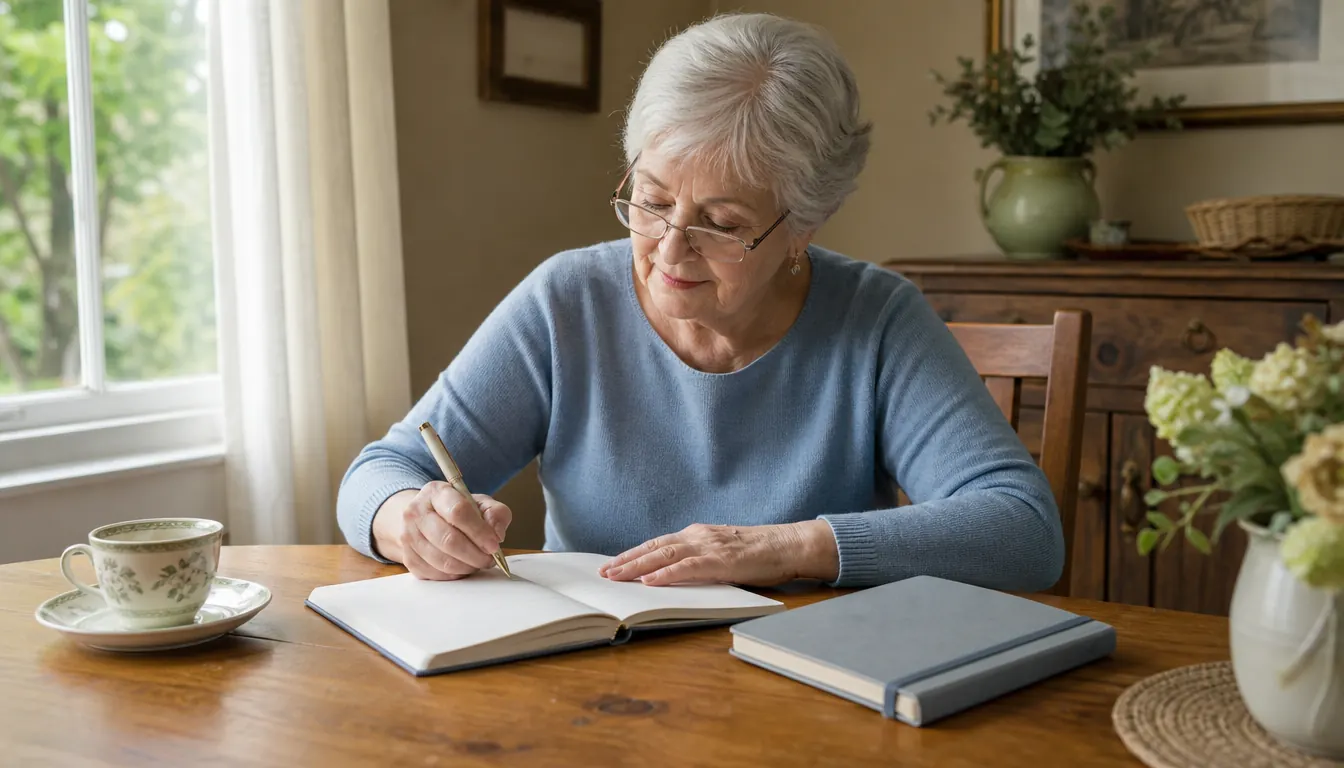
The book lives on the dining table, which is where I do anything that needs a flat surface and quiet. Sunday afternoon, after the lunch dishes are done and before Walt starts his programs in the den, I sit down with a ballpoint pen and work through whatever is next. I wear bifocals and I have not had to fight with the page. Some weeks I do four pages. Some weeks I do one and then go out and deadhead the marigolds, which counts as thinking.
By autumn I was past the halfway mark. That is roughly five months of Sundays, which is worth telling a grandchild who is imagining a finished book under the tree next Christmas. It is not a weekend project and it is not meant to be. The pace is the point. You write a little, you leave it, you come back with something you had forgotten, and the book gets better because you did not try to do the whole thing in one go.
The Prompts, and Where They Get Hard
The pages move through a life rather than jumping around. Early on I was writing about the house I grew up in and the way my mother ran her kitchen, and later I was writing about work and about my own two children. I have answered pages about school, about the war years my parents would not discuss, about how Walt and I met at a church supper in 1972 and how little I thought of him that first night. The prompts are specific enough to start you and open enough that you are not simply filling in blanks. That balance is harder to strike than it looks.
Where it gets hard is the pages that ask you to be honest rather than nostalgic. I have skipped two, written a paragraph, crossed it out, and come back a month later with a better answer. A grandchild reading this in thirty years does not need a polished grandmother. He needs one who says the winters were long, the money was short, and she was tired for about four years straight. The book gives you room to say that. It does not make you.
I have written about my mother's kitchen and the summer I worked the counter at a department store downtown. Neither one would have come out of me if a page had not asked.
There is also a generational gap in a few of the prompts, and it is not the book's fault so much as the world's. A page that assumes a career with a retirement party and a gold watch did not quite fit my sister Ruth, who worked accounts for a decade and then stopped when her husband got sick. I answered it anyway and made it fit. That is what you do with a prompt. It is a starting line, not a fence around the field.
What Surprised Me
What surprised me most is how much came back that I had not thought about in forty years. The name of the woman who lived next door. The particular smell of the cloak room at the school where I taught. The way my father whistled when he was pleased and said nothing at all when he was not. A person's memory does not open on its own. It opens when something knocks on it, and a printed page is a polite way of knocking.
I have gone back and read the first twenty pages twice now. The early entries are the shakiest, because I was still writing as though somebody were grading me. By page forty I had stopped performing and started telling. If you give this to a grandmother, expect the first few pages to be stiff and formal. Leave her alone and the voice arrives on its own.
The second surprise is that the book became a reason to talk. My granddaughter, who is 16 going on forty, saw me writing one afternoon and asked what it was. We ended up on the porch for an hour with her asking follow-up questions, which is more or less the whole point of a gift like this. The book is not the relationship. It is a way to start one at the table.

The Parts I Do Not Love
Nobody writes a review of a keepsake journal and says the trouble is that it is a lot of writing, so let me say the true thing instead. This is a lot of writing, and there will be months when it does not happen. I lost most of August to a kitchen remodeling that was supposed to take two weeks. The book sat there with a pen on top of it and I felt mildly accused every time I walked past. That is a me problem, but it is a real feature of the gift.
The other part I do not love is that a single copy covers a single life. That sounds like a complaint about cost, and it is not. It is a complaint about expectation. If a family buys one of these for Grandma and assumes it will capture everybody's memories, they will be disappointed. It captures hers. If you want Grandpa's too, that is a second book and a second set of Sunday afternoons, and you should say so out loud before somebody is hurt by it.
What I Liked
- 122 pages that move through a whole life in order instead of jumping around
- Light at 9.1 ounces, so it stays on the table instead of the shelf
- Prompts specific enough to start a memory without dictating the answer
- A finished copy becomes a keepsake the family will genuinely open
- One clear owner, so there is no confusion about whose story it is
Where It Falls Short
- Demands months of steady writing, not a weekend
- No room for a spouse's version of the same years
- A few prompts assume a conventional career and need adapting
- Will sit untouched in a house where nobody likes to write
What It Is Not
It is not a fill-in-the-blank family tree, and it will not produce names and dates for you. It is not a photo album, and there is no pocket for pictures. It is not a book you can read in an evening and then hand over with good wishes. And it is not a substitute for sitting down with the woman and asking her things out loud while she is still here to answer. If anything, it works best as a companion to that.
One more thing it is not. It is not a gift that flatters the giver. The grandson who gave me this did not get a thank-you note and a shelf ornament. He will get a book in his grandmother's handwriting, and that is a different sort of present that takes a few years to arrive.
Who This Is For
This is for a grandmother who writes. Letters, lists, a diary, long notes in birthday cards, the shopping list with a paragraph on the back. It is for a woman who tells the same stories at the table and enjoys being asked about them rather than tolerating it. It suits a family that will remember to ask, once in a while, how it is going. Those three things together, a writer, a talker, and a family that nudges gently, and the book will be full inside a year.
Who Should Skip It
Skip it if the woman you are shopping for has arthritis bad enough that holding a pen for an hour is a chore. Walt's hands are not what they were, and he would not thank anyone for this. Skip it if she has told you plainly that she does not like writing, or if she is grieving and not ready to walk back through a life page by page. And skip it if the family will not read it. A filled journal on a shelf is still a keepsake. A blank one is a small reproach.
If You Are the One Buying It
Give it with a pen, a decent one that is comfortable in an older hand, and no instructions attached. Do not say it is for the family or that it will be lovely to have. Say you want to know what her kitchen smelled like when she was nine. Then ask her about it in March. The thing that made this work for me was not the book at all. It was that my grandson asked, in June, whether I had reached the part about his great-grandmother yet. He had not read a word. He just wanted to know, and a question like that will carry a grandmother through a page she has been putting off.
My sister Ruth is 68, widowed, and lives alone in Harrisburg. She is the first person I would hand one of these to, except that Ruth has never written more than a grocery list in her life and tells me so whenever the subject comes up. That is the honest dividing line, and it has nothing to do with age or education. It is whether the woman enjoys the act of putting words on paper when nobody is making her.
If she is a writer, she will fill it. If she is not, buy her something else.
122 pages, a lifetime of prompts, and one clear owner. That is the whole offer, and it is a good one for the right grandmother. Check the current price and decide honestly whether she is that grandmother.
Amazon Check Today's Price on Amazon →