
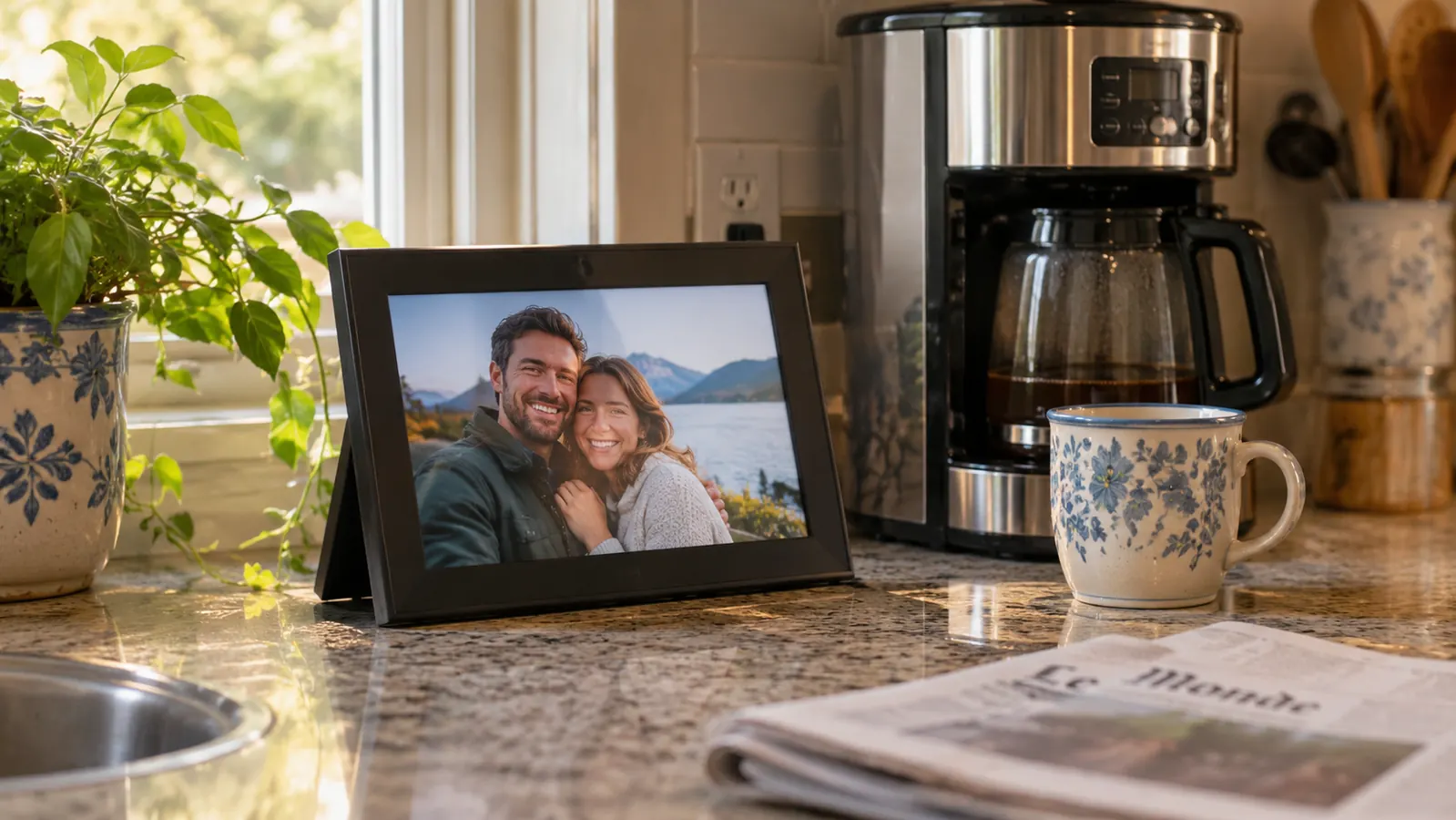
The Skylight frame came into our house on Christmas morning 2024, and my daughter had it running before I finished my second cup of coffee. Fifteen minutes, most of it her talking me through it over the telephone. By the time she hung up, a photograph of my oldest grandson at his winter concert was sitting on the kitchen counter beside the coffee maker. I never opened a manual, and I am not the person in this house who is good with devices.
That is the version of the story the frame tells about itself, and it is true as far as it goes. What I want to give you is the rest of it. Sixteen months of living with that screen in the busiest room of our house, plus a second Skylight frame I bought for my sister Ruth in Harrisburg last spring. There are things about this frame that the product page cannot tell you, mostly because they are about people rather than about hardware.
The Quick Verdict
It does exactly what it says and asks almost nothing of the person who owns it. It asks a good deal of the family, and nobody puts that on the box.
Amazon Check Today's Price →Fifteen minutes to set up, then the work belongs to your family
The Skylight frame arrives with a cord and a screen you can touch with a knuckle. If your children or grandchildren will actually send photographs, this is the frame to buy. If they will not, no frame on earth will change that.
Amazon Check Today's Price on Amazon →What Nobody Tells You: The Frame Needs a Family
A digital frame is not a toaster. A toaster works alone. This thing is only as good as the people feeding it, and that is the sentence I would print on the box if anyone asked me. When our daughter gave us the Skylight frame, she did not simply hand over a device. Over the following week she added herself, her brother, and all five grandchildren to the frame's email address, and that is the reason the screen in our kitchen has never once gone stale.
If nobody in your family is willing to do that part, the frame will display the same twelve photographs until the end of time, and you will have bought a screen that shows one summer forever. I have watched this happen to a neighbor. Her frame has shown the same three pictures since the week her son set it up, because he never showed her how to add more and he has not thought about it since.
So the honest first question has nothing to do with Skylight. Who in your family is going to send the photographs? If the answer is a daughter who already texts you pictures every week, you are set. If the answer is a son who calls twice a year, you are going to be looking at a quiet screen and feeling something you did not bargain for.
How It Actually Works in an Ordinary Kitchen
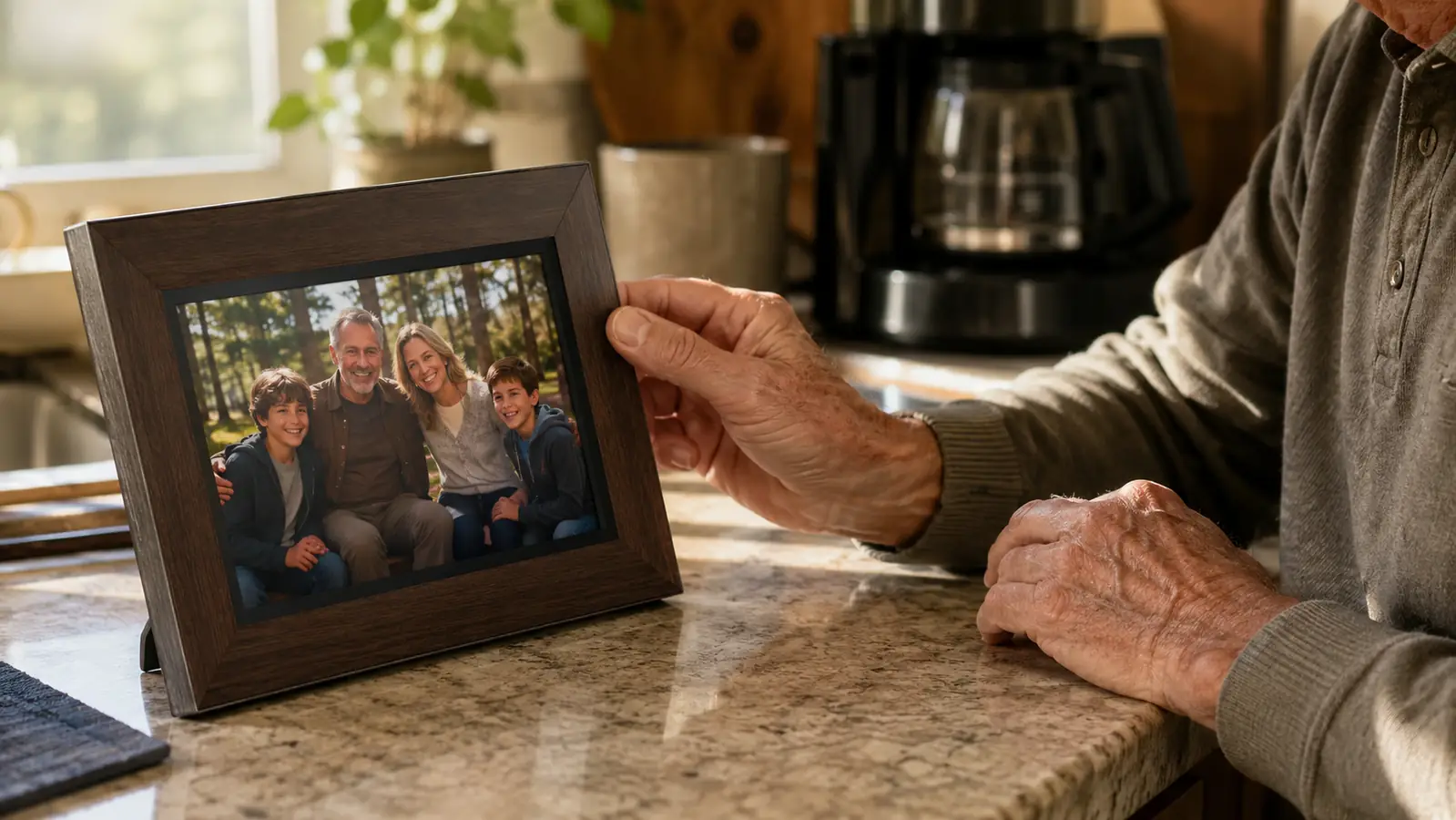
The frame lives on our kitchen counter to the left of the coffee maker, and it has become the first thing I look at in the morning and the last thing I look at before I turn out the light. Photographs arrive by email, sent to the address the frame is given when it is set up, or they come from the phone app when someone prefers to load them that way. Both routes work. Neither one requires a person to touch the frame itself.
That matters more than it sounds. Walt is seventy-five and spent thirty-five years at a lathe, and his hands have the arthritis to prove it. He does not have to do anything to this frame. No card to plug in, no cable to hunt for, no sequence of buttons to remember. The pictures simply appear, the way mail used to. He looks up, says something about how tall the youngest one is getting, and goes back to his coffee.
The screen is ten inches across at a resolution of 1280 by 800, and it is a touchscreen, so I can tap it along if I want to see what comes next. I do that less than you would think. After a few weeks the frame stops being a device you operate and becomes a thing on the counter you glance at, which is the highest compliment I can pay it.
Walt has never once pressed a button. The photographs simply arrive, the way mail used to, and he looks up from his coffee and says something about how tall the youngest one is getting.
The Setup, Honestly
I want to be exact about setup, because this is where reviews get vague and the reader gets surprised. Our daughter did it, not us. She plugged the frame into the wall, connected it to the Wi-Fi in the house, and chose the email address that photographs would be sent to from then on. The whole thing took about fifteen minutes, and most of that was her explaining to me which end of the cord was which.
I am telling you that plainly because I do not want you buying this for yourself at seventy-two and expecting to breeze through it if you are the sort who calls the library when the computer acts up. It is not hard. But it is a wireless setup, and wireless setups have a way of turning into a forty-minute call with a grandchild. Plan on that and you will be fine. Plan on nothing and you may be cross.
If you are the one setting it up for a parent, do it in person when there is any way to manage it. Not because the setup is complicated, but because the value is in what happens afterward. Take five minutes to send a photograph from your own phone while you are standing there, so your mother watches the whole thing work before you leave the house. She will trust it more for having seen it.
The one I did myself was the second frame. I bought one for Ruth in the spring of 2025 and set it on her living room end table in Harrisburg with my grandson walking me through it on speakerphone. It went faster the second time. That is not a compliment to my abilities. It is just how these things go.
What Older Hands and Eyes Will Notice
I wear bifocals and Walt wears reading glasses, and neither of us has any trouble with this screen from across the kitchen. The ten-inch size is right for a counter. Bigger would take over the room and smaller would be a thing you have to walk over to. I have seen both arrangements in other people's houses and I would not trade.
The glass does not turn into a mirror when the morning sun comes through the window over the sink, which was my worry before we had it. The photographs are bright enough to see without fussing with anything. When the afternoon light hits it at an angle there is some washout, and that is the worst I can say about how it looks.
Walt's hearing is not what it was, and I bring that up because it is part of why this suits him. It asks nothing of his ears. Nothing about it needs to be heard. It is a silent object that changes on its own, and in a house with a man who has mostly stopped answering the telephone, that quiet is worth something.
I should mention the touchscreen, because I was sure it would be a nuisance and it has not been. Nobody bumps it in passing. When the grandchildren visit they want to tap their way through the pictures themselves, which turns into a whole business of naming people and arguing about years. The seven-year-old is very good at it. She finds herself in the summer of 2024 and announces it to the room.
What Surprised Me After a Year
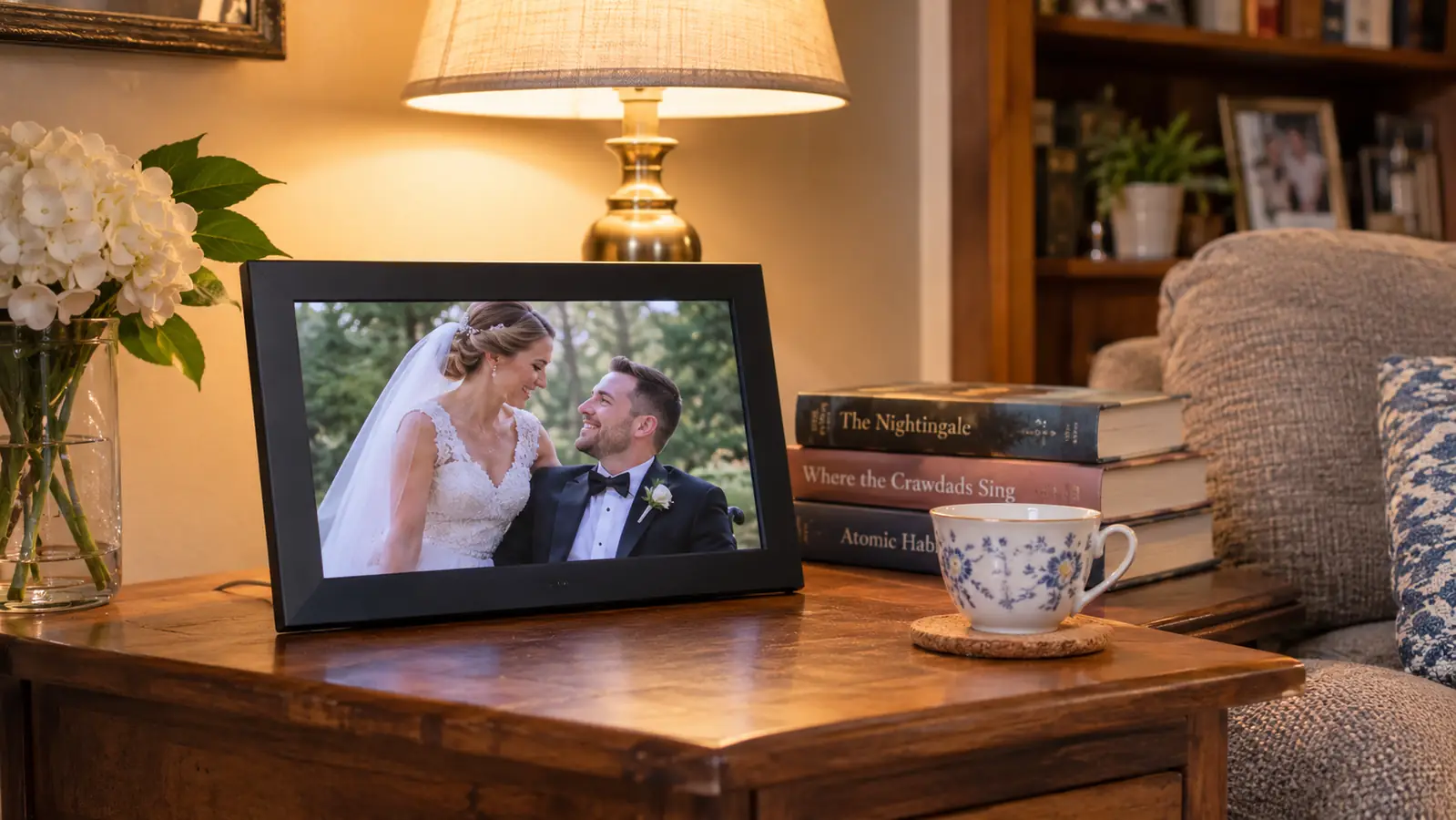
Two things surprised me. The first is how quickly the frame stopped being interesting as an object and started being interesting as a window. In January I caught myself standing at the counter with a dish towel in my hand, looking at a photograph of my granddaughter in a snowbank. I had already seen that photograph on my phone. Seeing it again, four feet from the kettle, is not the same experience, and I cannot explain the difference to you. I only know there is one.
The second is what it does for Walt. He does not use the app and he would not thank you for suggesting it. But he will stand at that counter and look, and then he will say that one is getting tall, and I will know exactly which one he means without asking. A telephone call would not have produced that. A photograph, sitting in the room, did.
Where It Falls Short
I want to be fair here, because most of what can go wrong with a digital frame is not the frame's fault. The hardware on our counter has done its job for sixteen months without a complaint. The complaints below are mostly about the arrangement a frame like this requires, and about the two or three small ways the Skylight frame makes that arrangement a little harder than it needs to be.
The first is the cord. This is a corded frame, so it wants a wall outlet, and it is not a thing you can set on a shelf across the room from the nearest socket without a line running along the baseboard. In our kitchen that was easy. In Ruth's living room we moved the end table six inches and called it settled.
The second is storage. The frame holds eight gigabytes of photographs, which sounds generous until you have five grandchildren and a daughter who sends eleven pictures of a birthday cake. When it fills, somebody in the family has to go in and clear out the old ones. That somebody will not be me. I know this about myself, and I know it about Walt, who has never once opened the app.
The third is offline mode. The frame will keep showing the photographs already on it when the connection drops, which is a comfort in a storm. What it will not do is receive anything new until the Wi-Fi comes back. That sounds obvious. It stopped being obvious the week our router died and I spent three days cross with my children for not sending pictures.
The fourth is smaller but real. When a frame is new, everybody sends everything. By month four the photographs thin out to a trickle, and by month eight you are getting one picture of a snowman in January. The frame has not changed. The family has. I do not know of a fix for that except being the sort of person who asks.
What I Liked
- Set up once, then nobody has to touch it: photographs come by email or straight from the phone app
- Ten-inch touchscreen at 1280 by 800 is easy to see from across a kitchen in bifocals
- Walt has never had to press a button, which is the whole point with arthritic hands
- Offline mode keeps the photographs already loaded on the screen when the Wi-Fi goes down
Where It Falls Short
- Corded, so it needs an outlet close by and a line along the baseboard
- Eight gigabytes fills faster than you expect when a large family is sending pictures
- Somebody in the family has to clear out old photographs and keep new ones coming
- The sending end of it wears off by about month four, and no setting fixes that
Who This Is For
This frame is for a household where at least one person under sixty is willing to be the pipeline. That is the whole test. If your daughter already sends you photographs and you have to squint at them on a telephone, the Skylight frame gives those photographs a place to live that you can see from the sink. My sister Ruth is sixty-eight, widowed, lives alone, and her frame on the end table is the reason she knows what the family looks like between visits.
It is also for the grandparent who does not want to learn anything. I mean that kindly. Some people take to new devices and some people have decided they are finished taking to new devices, and this frame respects the second group. There is nothing to learn. There is something to look at.
And it is for the adult child doing the buying, because it is a gift that keeps working after the wrapping paper is gone. The last photograph our daughter sent was of my grandson's new apartment. I saw it before she called to tell me about it. That is worth something, and it is not the kind of thing you can put a figure on.
Who Should Skip It
Skip it if you live alone and the family does not send photographs. I am serious about this one. A frame is a mailbox, and an empty mailbox is a sad object in a quiet house. If you are buying it for yourself, be honest about whether the pictures will actually come. If they will not, buy a printed album and be content with it.
Skip it if the outlet situation is bad. This is a corded frame and there is no way around that. A mantel with no socket, a shelf above a doorway, a hutch where the cord would dangle down the front of everything, all of those are the wrong place for it. Measure the distance to the nearest outlet before you get attached to a particular spot.
And skip it if you want a screen that does a great many things. This one does one thing. The Skylight frame shows photographs and takes photographs, and that is the whole of the arrangement. I have known people to be disappointed by that. I have never once been disappointed by it.
One last thing, and then I will leave you to it. If you are buying this for a parent, do not buy it silently. Tell them what it is for and tell them who will be sending pictures. The frame on our counter is not valuable because of the glass or the resolution. It is valuable because my daughter decided, one Christmas, that her parents should see the family between visits, and then did the work of making that happen. The frame is just the thing that holds the result.
Buy it for the person who will never read a manual
Sixteen months on our kitchen counter, and the only upkeep it has ever needed was somebody in the family remembering to send a picture. If your family will do that, this is the frame. If they will not, take the grandchildren to lunch instead.
Amazon Check Today's Price on Amazon →