

My grandson gave me a book for Mother's Day and said, in the way nineteen-year-olds do, that he wanted to know what my life was like before he existed. I am 72 years old. I have been on the receiving end of a great many gifts in my time, and I could tell you exactly which ones went straight into the hall closet. That book did not go into the closet. It is on the dining table right now, a little past halfway done.
What follows is how I have actually used it, not how a publisher says to use it. The book is called Tell Me Your Life Story, Grandma, it comes from Questions About Me, and it is a guided journal: 122 pages, 7 by 10 inches, light enough at 9.1 ounces to carry from the kitchen table to the den and back. But the book is the easy part. The hard part is getting a grandparent to sit down, and getting the family to ask in a way that does not feel like homework. Here is the order that worked in this house.
The Book That Started All This, If You Would Rather Skip to It
122 pages of prompts, 7 by 10 inches, 9.1 ounces, and nothing to charge, download, or set up. This is the edition I am working through.
Amazon Check Today's Price on Amazon →Step 1: Ask First, and Let Them Say No
The biggest mistake families make is turning a keepsake into a surprise. A journal is not a box of chocolates. It is an assignment, however gentle, and the person holding it has to do the actual work. So ask. Ask plainly, and mean it when you say that no is a perfectly good answer.
I will use my husband as the cautionary tale. Walt is 75, a retired machinist, and he would sooner have a tooth pulled than fill a book with stories about himself. He is not being modest. He genuinely does not believe anyone wants to read it. Hand him a guided journal tomorrow and he would thank you warmly, put it on the shelf, and never open it again. His own mother would have talked for a week. Same family, two completely different people.
So the asking matters. Do not say, 'I got you this, you should fill it in.' Say something closer to: 'I want to know about the house you grew up in, and I do not know how to ask. Would you work through this with me, a little at a time?' Then stop talking and wait. If the answer is not yet, leave the book with them anyway and do not mention it again for a month. Nagging a person into a memory book produces a very short memory book.

Step 2: Buy a Journal With Prompts, Not a Blank Notebook
Everyone's first instinct is a nice empty notebook with a ribbon in it. I have watched this fail more times than I can count, and I have been the one it failed on. A blank page asks you two things at once: remember something worth telling, and then figure out how to shape it into a story. That is a writer's job. Most people are not writers and know it perfectly well, so they write their name on the inside cover and stop.
A guided journal removes the first question entirely. You open it, there is a prompt, and you answer the prompt. That is the whole difference, and it is why the Tell Me Your Life Story, Grandma book from Questions About Me worked where a notebook would not have. The prompts do the asking for you. On a Sunday when I have nothing to say, I do not have to invent anything. I turn the page and the page already has a question waiting.
A word on the physical book, because this matters more as your hands and eyes get older. It measures 7 by 10 inches, which is generous enough that handwriting has somewhere to go and small enough to hold flat against a table with one hand. It weighs 9.1 ounces, so it is not a doorstop. It runs 122 pages and was published in April 2021. That page count is worth understanding before anyone starts: it is a year or more of Sunday afternoons, not a weekend project. Knowing that up front is the difference between a slow book and an abandoned one.
Step 3: Pick One Small Slot in the Week and Protect It
The people who finish these books are not the ones with the most discipline. They are the ones who attached the book to something that already happens every week. In my case that is Sunday afternoon at the dining table, after the dishes are done and before Walt turns the news on. Pen, book, twenty minutes. No ceremony, no candles.
Twenty minutes is deliberate. When I first started I thought I would do a full hour on Sundays and be finished by summer. That lasted two weeks. An hour of writing about your own childhood is surprisingly tiring, and if the first sitting exhausts you, you will not come back for the second. Three or four prompts is a good afternoon. By the following autumn I was a little past halfway through, and I had missed plenty of Sundays along the way. The book does not scold you for the gaps.
Do not save it for a holiday, either. The temptation is to sit down at Thanksgiving and try to get through twenty pages with the whole family watching. That produces short, careful answers, the kind you give a stranger at a bus stop. The good material comes out on an ordinary Sunday when nothing is at stake and nobody is waiting.
Step 4: Fix the Light, the Pen, and the Chair Before Anything Else
This is the step nobody writes about and it is the one that decides whether the book gets finished. I wear bifocals. Walt wears reading glasses and has arthritis in both hands. If you are buying this for someone in their seventies or eighties, assume the body is part of the setup and plan for it.
Three things. First, light. Not a lamp behind you casting your own shadow on the page. A lamp over your shoulder or to the side, and daylight if you can get it. Second, the pen. A cheap ballpoint that skips makes you press harder, and pressing harder is what makes a hand ache after two pages. A rollerball or a gel pen glides. Walt would need one with a thicker barrel, because his fingers cannot close tightly around a thin pen for long, and if he were the one writing we would have bought that before starting rather than after the first complaint. Third, the chair. Write at a table with your feet flat on the floor. Writing in a recliner with the book propped on your knees is how you get a cramp and a grudge.
And when the hand gives out, stop for the day. Nobody is grading this. Half a page in comfortable handwriting is worth more to your family than three pages you resented every line of.
I have filled a little past half of 122 pages, one Sunday afternoon at a time, and my grandson has heard more family history in one year than I managed to tell his mother in forty.
Step 5: Hand It Back and Read It Out Loud Together
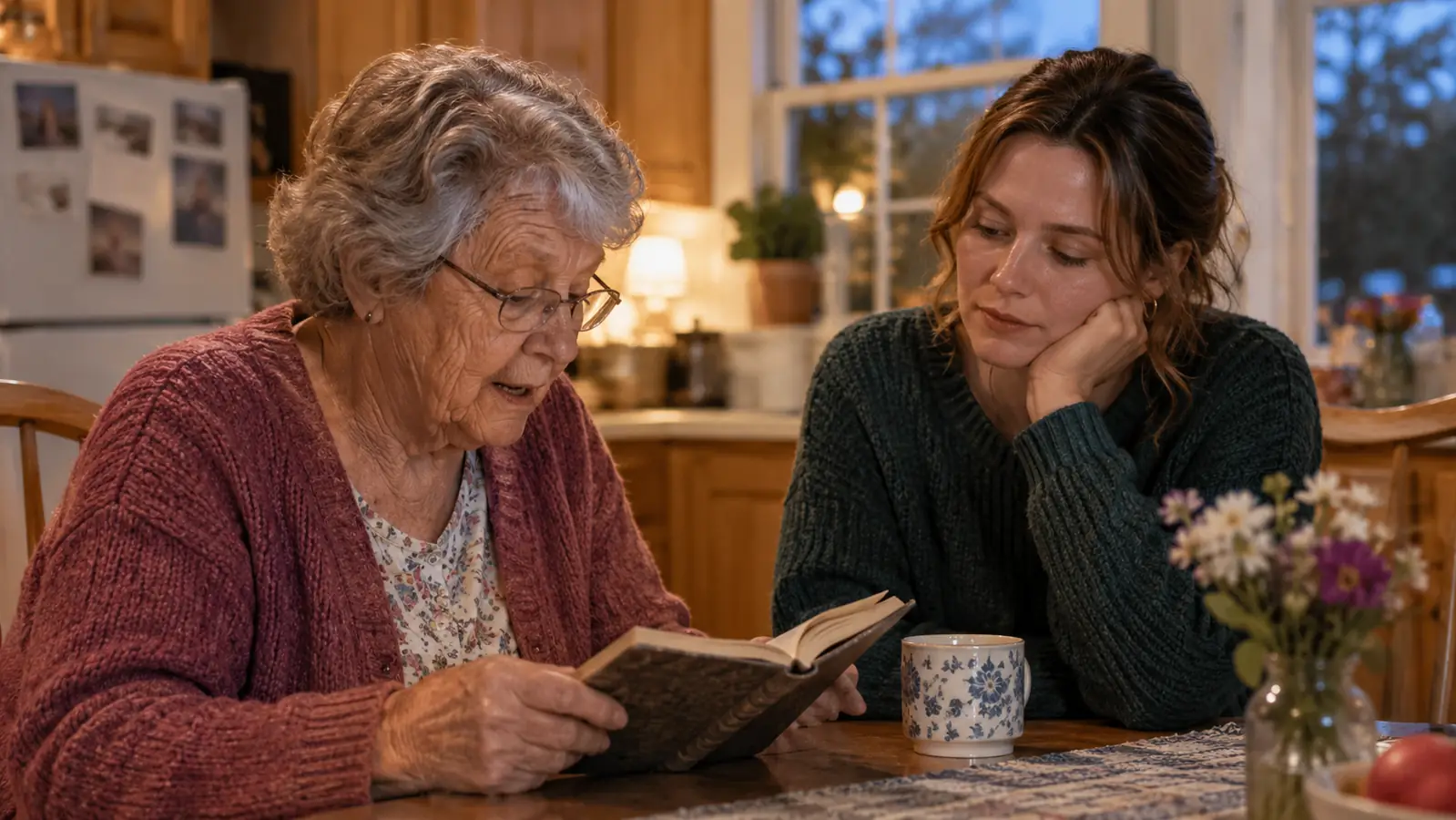
The book is not the point. The conversation is. About once a month my grandson and I go through whatever I have written since the last time, and he reads it, or I read it to him if the room is noisy. Some of the entries are dull as dishwater. Some of them produced a follow-up question I did not expect, and then a story I had not thought about in fifty years came out of nowhere.
Do not wait until the book is full to share it. This is the mistake I nearly made, and I am glad I did not, because a keepsake that stays closed for two years is just a diary with better binding. A keepsake that gets read aloud gets added to. The person listening asks something, and you suddenly remember the rest of it.
One practical note from this house: Walt has moderate hearing loss in both ears and does not wear hearing aids yet, so if he is in the room I read louder than feels natural. If you are reading to someone with a hearing problem, sit where they can see your mouth. The amplified phone in our kitchen has a volume boost that helps on calls, but there is no boost button for a dining table.
What Else Helps
Keep photographs within reach. My answers got longer and more specific once I had a shoebox of old pictures open on the table next to the book. A face, a front porch, a car nobody in the family remembers will pull out details that a prompt alone will never reach. Those details are the part your family cannot get anywhere else, and they are usually the part that ends up being repeated at the next reunion.
Let someone else do the writing if the hand tires. My sister Ruth is 68, widowed, and lives alone in Harrisburg, and she has said more than once that she would happily answer a book like this if someone sat with her and held the pen. That is a perfectly good arrangement. Your grandparent talks, you write, and you put the date at the top of the entry. The handwriting is not the keepsake. The words are.
Record the long ones on your phone. I use my tablet for photos and video calls and that is about the limit of my interest, but the voice recorder is simple enough even for me. When a story starts running long and the pen cannot keep up, press record, let them talk, then write the short version into the book afterward. The written answer is what gets handed down. The recording is for you, and for the day you want to hear that voice again.
And do not correct anybody. Not the spelling, not the dates, not the order things happened in. If the person writing says the family moved in 1958 and you are certain it was 1959, write 1958 and let it stand. It is their account of their own life. The whole value of the thing is that it sounds like them and not like a fact-checked family history.
Who This Is For, and Who It Is Not
It suits a grandparent who enjoys talking about the past but needs a nudge to aim it somewhere. It suits a family that will actually sit down with them rather than mail the book and hope. And it suits the person who wants to give something better than another scented candle and genuinely does not know where to start. The Questions About Me edition is the one on my dining table, filled in page by page, and it is the one I would hand to a friend. If that is you, this is a reasonable place to start.
It does not suit someone who has already told you no. It is not a good fit for a grandparent with significant memory loss, or at least not without someone sitting alongside to prompt and fill the gaps, because a page of questions can turn into a page of apologies. And it does not suit a family that wants a finished book by Christmas. A few prompts a week across 122 pages is a long project, and the length is a large part of why it works.
If You Are Going to Ask, Have the Book Ready When They Say Yes
The prompts are already written, all 122 pages of them, so the only thing left to arrange is twenty minutes on a Sunday and a pen that does not skip.
Amazon Check Today's Price on Amazon →